
I designed and built an audio phaser signal processor modeled after the effects heard in classic guitar pedals.
The system used a chain of all-pass filter stages with time-varying resistances to periodically shift phase and create the characteristic “swooshing” heard when you press down a guitar pedal.
I began the design in LTSpice, modeling a single all-pass filter stage to understand how phase varied with frequency and to verify that a variable resistance could modulate the filter’s cutoff. Simulation allowed me to sweep resistance values and observe the shifting notch frequencies before I built out the circuit.
After this, I built the first stage on a breadboard, introducing a variable resistance using an NMOS transistor biased in the linear region. By applying a periodic sinusoidal gate voltage with a DC offset, I was able to modulate the transistor’s channel resistance and shift the filter’s critical frequency in real time.
After confirming the principle worked, I cascaded four all-pass filters to construct the complete phaser network. For recombination, I designed an op-amp summing amplifier to blend the dry input signal with the processed output. When selecting op-amps, I evaluated specifications such as gain-bandwidth product and slew rate to ensure they could handle the audio frequency range without distortion or excessive phase error.
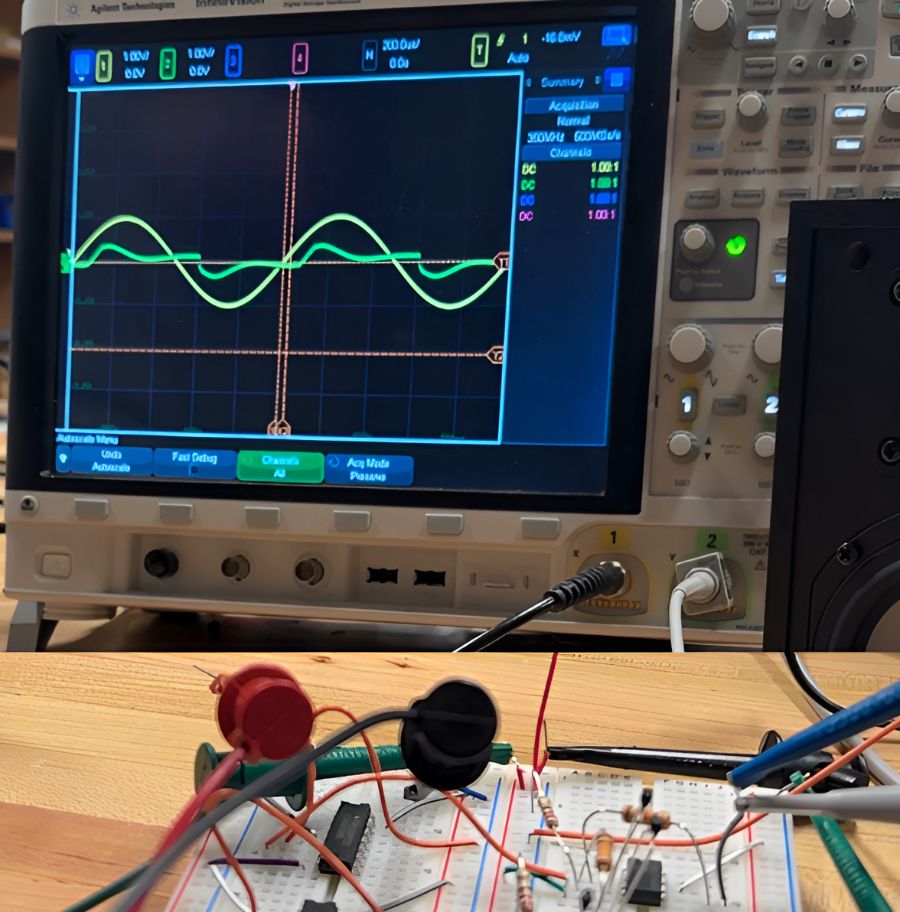
Testing began with pure sine wave inputs to confirm that the output magnitude varied periodically, then moved to recorded guitar and music tracks to evaluate the audible effect. I listened to the output through an amplifier and speakers, fine-tuning the modulation waveform and frequency. I also experimented with adding feedback paths around the filter cascade, which deepened the notches and created more dramatic tonal textures.


The completed phaser produced the expected periodic frequency cancellations and reinforcements, recreating the "swooshing" effect characteristic of commercial guitar pedals.
The NMOS-based design achieved smooth resistance modulation at around 0.5 Hz and stable operation during audio tests.


